
Date:
Location:
Speaker: Francesca Fiorani (University of Virginia / I Tatti)
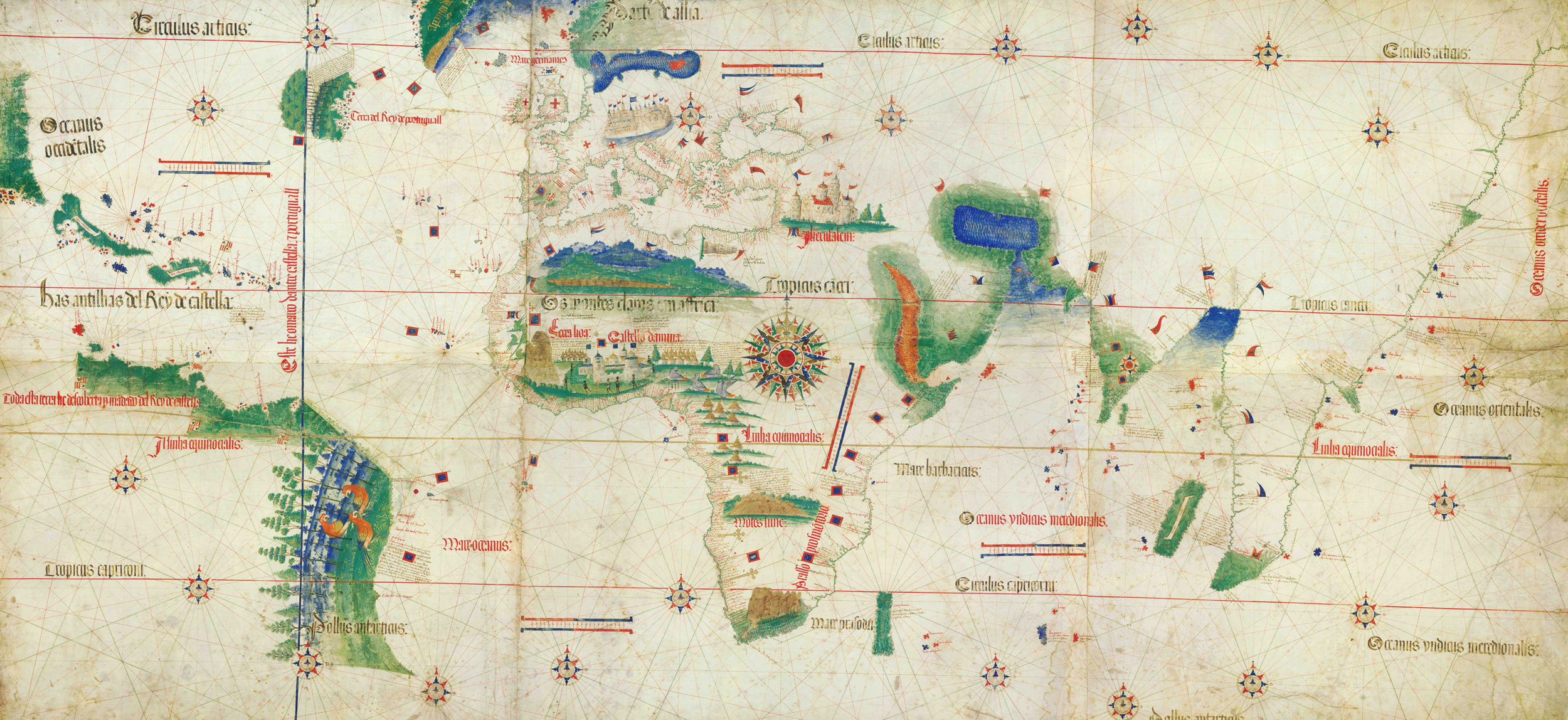
This seminar focuses on a famous nautical chart known as the Cantino Map, named after Alberto Cantino, the man who smuggled it out of Lisbon in 1501 to deliver it to the Duke of Ferrara, Ercole I. Hand-drawn on vellum, it is a luxury item valued for its geographical information which represents the world as Europeans knew it in 1501, right after Pedro Álvares Cabral had returned to Lisbon from his voyage to India, at a moment when things were shifting and had not yet been fully codified—among them, the names of places and the possession of lands. This talk will examine the map in the context of European and non-European knowledge of navigation and mapping, within European perceptions of Africa, and in relation to trade in the Indian Ocean. It extracts from some of the map's details the cumulative knowledge that is behind its making, a knowledge that is predicated on the exchanges between the Portuguese and the people they met along their travels.
Francesca Fiorani is Commonwealth Professor of Art History and President of the Society of Fellows at the University of Virginia, where she served also as Associate Dean for the Arts and Humanities and Department Chair. A Guggenheim fellow, she writes on cartography, scientific images, optics, and Leonardo da Vinci. Her last book The Shadow Drawing: How Science Taught Leonardo da Vinci How to Paint (2020; pb 2022) was reviewed widely, including in the Wall Street Journal and the New York Times. She is also the author of The Marvel of Maps: Art, Cartography, and Politics in Renaissance Italy (2005; e-book 2022) and of Leonardo da Vinci and His Treatise on Painting (2012). Her current research focuses on world travel around the year 1500.
Image: Cantino Map, 1501-2. Modena, Biblioteca Universitaria Estense
Add event to calendar


